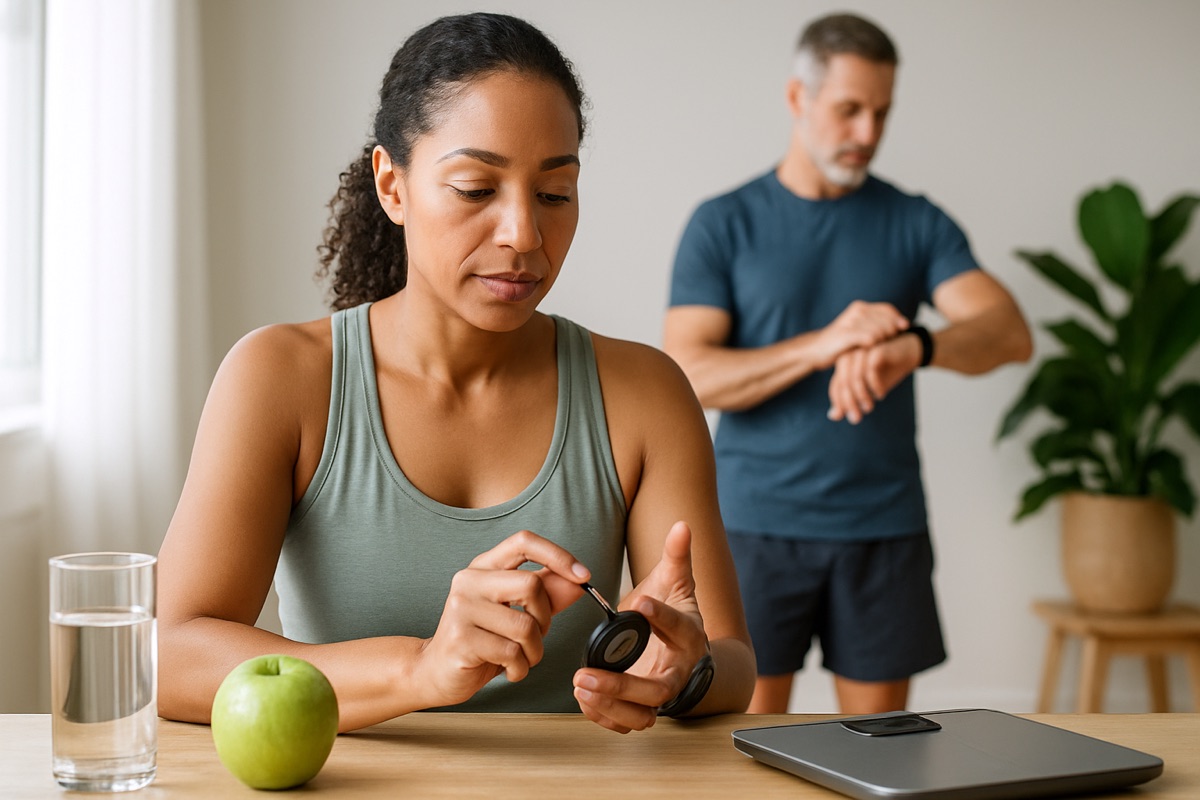
You wake up, reach for your phone, and the number is wrong. Your HRV was 48 last week. This morning it says 29, your recovery is red, and you have no idea why. You feel fine. You slept seven hours. You did nothing unusual.
Heart rate variability is the most-stared-at number on Oura, WHOOP, Garmin and Apple Watch, and also the most misread. It is a real physiological signal with decades of clinical research behind it. It is also noisy, deeply personal, and close to useless when you read one night in isolation. Here is what the number measures, what makes it move, what it predicts, and how to read yours without losing sleep over it — which, of course, lowers it.
What HRV actually measures
Your heart does not beat like a metronome. Between one beat and the next, the gap changes by milliseconds. That variation is not a fault. It is the signature of your autonomic nervous system: the vagus nerve pressing the brake (rest, digest, recover) against the sympathetic side pressing the accelerator (stress, effort, threat).
When the brake is working well, beat-to-beat gaps vary a lot and HRV is high. When your body is under load — infection, alcohol, hard training, poor sleep, unrelenting stress — the accelerator takes over, the gaps become regular, and HRV falls. High HRV means your nervous system has room to respond. Low HRV means it is already busy.
Most wearables report RMSSD (root mean square of successive differences), the metric that tracks vagal activity most directly. WHOOP calculates it during your deepest sleep. Oura averages repeated five-minute samples across the whole night. Some devices report SDNN instead, which is a different calculation on a different scale. That is the first reason your number and your training partner's number are not comparable — they may not even be the same metric.
Is my HRV normal? The honest answer
Search "normal HRV by age" and you will find confident charts. Treat them loosely. Across published studies, resting RMSSD in healthy adults spans roughly 19 to 107 ms. That range is so wide it is nearly useless as a personal benchmark.
Two things are reliable. First, HRV falls with age — roughly 1 to 2 ms per year after 30, steepest through midlife before it flattens out. A 25-year-old at 20 ms and a 65-year-old at 20 ms are in very different positions. Second, your own baseline is the only benchmark that matters. Genetics set much of your absolute level. Someone can be exceptionally fit and sit at 35 ms while a sedentary friend sits at 70 ms.
So stop asking "is 40 good?" and start asking "is 40 normal for me, and which way is it trending?"
What actually moves your HRV overnight
These are the levers with real evidence behind them, roughly in order of how hard they hit.
Alcohol — the biggest, most reproducible hit
This is the best-quantified effect in the field. A study of 4,098 Finnish employees across more than 12,000 recording nights found alcohol suppressed physiological recovery during the first three hours of sleep in a clean dose-dependent pattern: recovery fell by 9.3 percentage points at a low dose, 24.0 at a moderate dose, and 39.2 at a high dose. RMSSD dropped by about 2.0, 5.7 and 12.9 ms respectively.
Two findings deserve attention. Younger drinkers took the bigger hit — at a high dose, RMSSD fell about 10.9 ms in 30-year-olds versus 4.7 ms in 60-year-olds. And being fit did not protect anyone: regular exercisers showed the same disruption as sedentary participants. If your HRV cratered and you had two drinks, you have your answer.
Illness, days before you feel it
Falling HRV is one of the earliest signals your body sends when it is fighting something. In Mount Sinai's Warrior Watch study, HRV changes flagged the onset of COVID-19 up to seven days before a positive swab. In a controlled challenge study, wearable models detected H1N1 with about 92% accuracy and rhinovirus with about 88% accuracy before symptoms started.
The caveat matters: those numbers come from research models working on clean data, not from the readiness score on your wrist. A low HRV night is not a diagnosis. But an unexplained drop lasting several days, especially alongside a rising resting heart rate and breathing rate, is a genuine reason to back off and pay attention.
Training load, late meals, and heat
A hard session suppresses HRV that night and often the next. That is normal and expected, not a problem — it is the cost you paid for the adaptation. It becomes a signal when the number does not come back after two or three days of easier work. Late heavy meals, a hot room, and travel push HRV down for a related reason: your body is doing work while you are trying to sleep.
What low HRV predicts — and what it does not
The population evidence is strong and long-standing. A meta-analysis pooling 32 studies and roughly 38,000 participants found lower HRV predicted higher mortality across ages, sexes, continents and recording lengths. In patients with existing cardiovascular disease, pooled analyses put the risk of death about twice as high in the low-HRV groups. In broader samples, people in the lowest quartile of RMSSD carried roughly a 56% higher hazard than everyone else.
Now the limits, honestly. These are associations across populations, not verdicts on individuals. Low HRV travels with age, poor cardiorespiratory fitness, high visceral fat, broken sleep, heavy drinking, chronic inflammation and diabetes — and each of those does plenty of damage on its own. One genetics study found that measured HRV predicted mortality while genetically predicted HRV did not, which points to HRV being a mirror of your current state rather than a lever that independently sets your fate.
Read it accordingly. HRV is an excellent daily readout of load and recovery, and a decent long-run summary of autonomic health. It is not a fitness score, not a personality trait, and not a number to chase for its own sake.
How to actually raise it
Well supported. Exercise training works. A meta-analysis in sedentary adults found a moderate increase in RMSSD (SMD 0.57), and across healthy-adult trials the effect was larger still (SMD 0.84). Aerobic and resistance training both help, and consistency matters more than which one you pick. Drinking less is the fastest single change most people can make, given the dose numbers above. Regular sleep timing helps, and so does treating sleep apnoea where it is present.
Modest, and mostly acute. Slow-paced breathing at around six breaths per minute raises HRV sharply while you are doing it, and multi-week HRV-biofeedback programmes show real benefits for stress and emotional regulation. Whether that carries over into a durably higher overnight baseline is less certain — the during-session effect is far better established than the lasting one. Ten minutes a day is still worth it; just expect the payoff in how you feel rather than in the morning number.
Hype. Any supplement sold as an "HRV booster" is running well ahead of its evidence. Cold plunges raise HRV acutely through a cold-shock reflex, which is not the same thing as improving autonomic health. And one green recovery score does not prove your training programme is working.
Reading your own data without the noise
- Give it two to four weeks. Baselines need time to settle. Garmin takes around three weeks to establish your range, and needs at least four nights of wear per week.
- Compare your 7-day rolling average to your personal baseline, not last night to the night before. Typical night-to-night swing is around 10%, so most "drops" are noise.
- Act on two consecutive nights, not one. One low reading is weather. Three is climate.
- Read it beside resting heart rate and breathing rate. HRV down, resting heart rate up, breathing rate up is the classic illness or overreaching pattern. HRV down on its own, with everything else flat, is usually last night's dinner or a hard day.
- Ignore other people's numbers. Different device, different metric, different genetics, different age.
One more practical note on hardware: recent validation work found overnight HRV agreement with ECG was highest for the Oura Ring Gen 4, followed by Oura Gen 3, Polar and WHOOP. All of them are good enough to track your own trend, which is the only job that matters here. None of them is a medical device.
Where HRV fits in the bigger picture
HRV is a daily signal. It tells you how your nervous system handled last night, and over months it tracks the direction of your fitness, drinking, sleep and stress. What it cannot tell you is what is happening in your arteries, your metabolism or your inflammatory system. That is the job of blood markers such as ApoB, hs-CRP, HbA1c and fasting insulin.
Together they are far stronger than either alone. A slow decline in HRV over six months alongside a rising HbA1c is a much clearer story than either number by itself. That is why VitalNexa syncs your wearable data next to your lab results and folds both into a single Biological Age — so you can see whether your whole physiology is heading the right way, not just whether this morning was green or red. If you want a rough starting point before you connect anything, the free Biological Age Calculator takes about a minute.
This article is educational content, not medical advice. A persistently low or falling HRV — particularly with symptoms such as chest pain, breathlessness, palpitations or unexplained fatigue — should be discussed with a qualified clinician, not managed from an app.
Stop reading one night at a time. Sync your Oura, WHOOP, Garmin or Apple Watch to VitalNexa, put your HRV trend beside your blood markers, and watch what your Biological Age does over the next six months. Get started free.