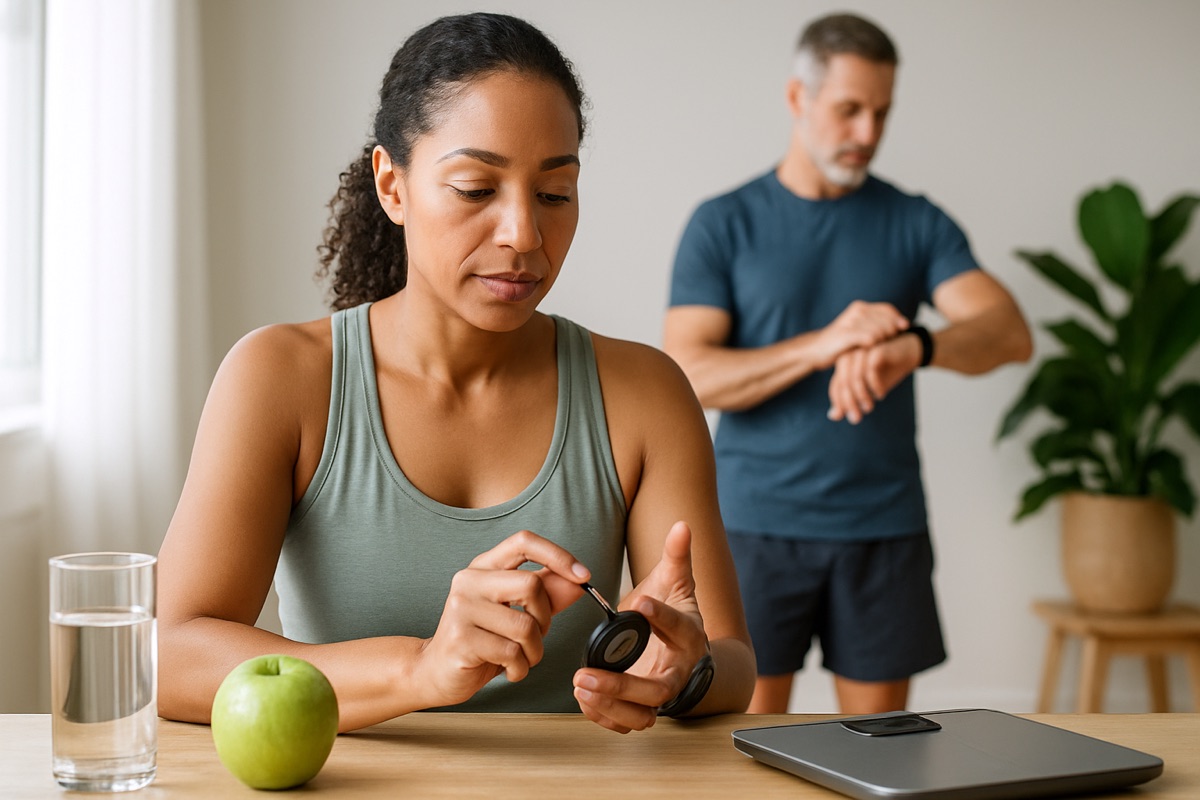
You can now walk into a pharmacy without a prescription and walk out with a continuous glucose monitor. Dexcom's Stelo and Abbott's Lingo put a sensor in the back of your arm, stream a glucose reading to your phone every few minutes, and show you a line that rises after lunch and falls again. For a lot of people the first two weeks are genuinely eye-opening. Oatmeal does that? A ten-minute walk flattens that?
Then the second question arrives, and it is harder: does any of it matter if you do not have diabetes?
The honest answer, based on what the research shows in 2026, is that a CGM is an excellent measuring instrument attached to a weak rulebook. The sensor is accurate enough. What nobody has proven is that chasing a flatter line makes a healthy person healthier. Here is how to tell the useful signal from the marketing.
What a CGM actually measures
A CGM does not measure blood glucose. It measures glucose in the interstitial fluid just under your skin, then applies an algorithm to estimate what your blood is doing. That fluid lags blood by roughly 5 to 15 minutes, which is why your sensor often shows a spike after you already felt it.
Accuracy is reported as MARD — mean absolute relative difference from a lab reference. In healthy adults without diabetes, published MARD values sit in the range of about 7% to 13% depending on the sensor and the conditions. A study of the Dexcom G6 during liquid glucose challenges in normoglycemic adults reported a median absolute relative difference around 7%. Analytical work on the FreeStyle Libre 2 in healthy men found an overall MARD near 13%, with essentially all readings falling in the clinically acceptable zones of the consensus error grid.
Translate that into numbers you would act on. At a true reading of 100 mg/dL, a 13% error band means the screen could legitimately say 87 or 113. Two sensors on the same arm can disagree by 15 points. So a "spike to 145" and a "spike to 130" are not different events — they are the same event seen through noise. Compare your own patterns to your own patterns, over days, and ignore single readings entirely.
Healthy people spike. That is not news, and it is not a diagnosis
The most quoted finding in this space comes from Hall and colleagues at Stanford, published in PLOS Biology in 2018. They put CGMs on 57 people with no diabetes diagnosis and found that even participants classed as normoglycemic by standard testing spent about 15% of their time in the prediabetic glucose range and around 2% in the diabetic range. They also described distinct "glucotypes" — low, moderate and severe variability patterns — within the same conventional diagnostic bucket.
That study is regularly used to sell sensors, and it is genuinely interesting: it showed that a single fasting glucose or HbA1c hides real differences between people. But it is a 57-person characterisation study. It did not follow anyone to an outcome. It did not show that the high-variability group got sick.
Larger data has since filled in the picture. A 2026 analysis in Nature Communications looked at CGM-derived time in range and variability across roughly 3,600 people in the ZOE PREDICT cohorts. More time in the tight 3.9–5.6 mmol/L range tracked with lower HbA1c, lower glucose on an oral tolerance test, lower carbohydrate intake and higher protein intake. In other words, the CGM metrics behave sensibly — they line up with the older markers we already trusted. That is a validation of the measurement, not proof that steering by it changes your future.
What the reviews conclude
Two things are worth separating: whether glucose variability is associated with risk, and whether wearing a CGM improves anything.
On association, systematic reviews of CGM use in non-diabetic adults for cardiovascular prevention report that variability measures — MAGE, coefficient of variation, time above range — correlate with markers of subclinical atherosclerosis and inflammation. That is a real, repeated signal.
On benefit, the same reviews are blunt. A 2026 systematic review with meta-analysis in the European Journal of Medical Research covering non-diabetic populations found no established evidence that CGM improves health outcomes or prevents disease in healthy people. Its more optimistic findings are modest: CGM can lower mean glucose a little, and it helps people stick to an intervention they were already doing. It does not, on its own, produce weight loss without a behaviour-change programme attached.
The reviewers also make a point that gets lost in the wellness version of this story: excursions inside the non-diabetic range are normal physiology in metabolically healthy people. Their presence is not disease and not, by itself, a reason to intervene. And the "optimal" targets circulating online — 96% time in range, peaks under 140, whatever your app shows in green — are author-proposed and extrapolated. None of them is a validated clinical standard for people without diabetes.
So who should actually wear one
Graded honestly:
- Strong case. You have prediabetes, a fasting glucose creeping up, an HbA1c of 5.7% or higher, a family history of type 2 diabetes, gestational diabetes in your past, or PCOS. Here you are not chasing optimisation — you are looking at a metabolic system with a known tendency, and the pattern is genuinely informative.
- Reasonable case. You want a two- to four-week education experiment. Learn which of your habitual meals hurts, learn what a post-meal walk does, learn what a bad night's sleep does to the next morning. That is a legitimate use of a teaching tool. Then take the sensor off.
- Weak case. You are metabolically healthy, your labs are clean, and you plan to wear one indefinitely to keep a line flat. There is no outcome evidence supporting this, the sensor noise is larger than most of the differences you would be reacting to, and the most common real-world result is narrowing your diet by fear rather than by evidence.
There is a documented downside to the last case. Cutting out fruit, legumes, whole grains and other fibre-rich foods because they nudge a curve upward is a nutritional loss trading against a benefit nobody has demonstrated. If you already have a difficult relationship with food, a device that scores every meal in real time is not a neutral object.
How to read your own data without fooling yourself
- Judge trends, never single points. With a 10%-ish error band, one alarming number means nothing. A pattern that repeats across five breakfasts means something.
- Test one variable at a time. Same meal, same time of day, two conditions: with and without a 15-minute walk. With and without protein first. That is an experiment. Eating differently every day and reading the curve is astrology.
- Discard day one. Most sensors are least accurate in the first 12 to 24 hours after insertion, and compression lows from lying on the sensor overnight produce phantom dips.
- Watch the fasting line and the return time. How high a meal takes you matters less than whether you are back to baseline within two to three hours, and where your overnight and morning glucose settles. Those are the parts that track with the blood markers that do have outcome evidence.
- Anchor it to a real lab. A CGM is a two-week window. HbA1c, fasting glucose and fasting insulin are the validated instruments. If your sensor suggests something, confirm it with blood.
The markers that still carry the outcome evidence
If your goal is metabolic health rather than an interesting fortnight, the ranking is not close. Fasting insulin and HOMA-IR detect insulin resistance years before glucose moves. HbA1c gives you a three-month average with decades of outcome data behind it. Triglyceride-to-HDL ratio is a cheap, useful proxy on any standard lipid panel. Waist circumference costs nothing.
CGM data is a valuable extra layer on top of those. It is not a replacement for them, and treating it as one is the single most common mistake in this corner of the internet.
This article is educational content and not medical advice — talk to a qualified clinician before making decisions about testing, medication, or managing a diagnosed condition.
Where a CGM earns its place is in context. A two-week glucose curve tells you very little in isolation. Sitting next to your fasting insulin, your HbA1c, your lipid panel, your resting heart rate and your sleep data, it becomes one more input into the question that actually matters: is your metabolic age moving in the right direction?
VitalNexa pulls your labs, your wearables and your supplement stack into one timeline and turns them into a single VitalNexa Biological Age you can track over time — so a glucose curve stops being a two-week curiosity and becomes part of a trend you can act on. Get started free.